
Every now and then, something will shake up the very foundation of the audiobook world. Recently, it has been Audible’s shift to offering AI voices for audiobooks. Understandably, audiobook narrators were shocked and appalled because their very livelihood is being threatened by a company many have worked with.
But what do audiobook listeners and fans think?
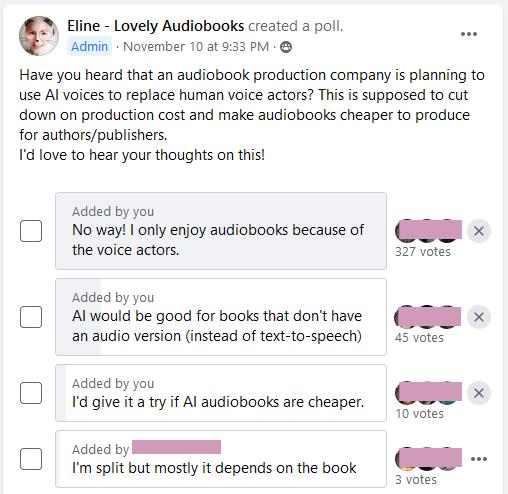
I asked in my Facebook group and got a lot of very interesting feedback. Below, you will find the arguments for and against AI audiobook voices from the point of view of avid audiobook fans. But first…
What are AI Audiobook Voices?
Well, it is basically a (more or less) advanced form of text-to-speech. Instead of having an app read an ebook to you, you are supposed to buy these audiobooks individually, though.
Their big advantage for companies like Audible is that they save the cost of an actual human voice actor. And AI audiobooks are faster to produce without any editing or post-production.
AI voices should be able to read the emotions in a scene from the context and adjust their narration accordingly. That’s where artificial intelligence comes in. The goal of AI voice developers is to have them be indistinguishable from human narrators, and they claim to already be there.
Related article: How to listen to Audiobooks (A Beginner’s Guide)
Concerns in regard to AI Voices for Audiobooks
Many common points of criticism we audiobook fans have when it comes to certain human narrators (e.g., because they aren’t experienced yet or don’t have enough training) translate into concerns about AI voices for audiobooks.
Is it easy to keep different characters apart during dialogue?
Can the listener recognize what a character is thinking versus what they are saying out loud?
Are inflection and pronunciation used correctly?
Does the narrator transport the emotions in a scene and draw us into the story?
Many people who only consume their books in audio format (be it because of a disability or circumstance) have experience with text-to-speech apps. Sometimes an ebook doesn’t have an audio version, and if we really want to read that story, text-to-speech might do in a pinch.
AI voices for audiobooks fall on a scale between experienced voice actors on the one side and text-to-speech on the other. When you think of a fiction novel with lots of dialogue and many emotions, a narrator uses a range of inflections and different voices to transport what is happening in the story. That makes it easier for listeners to follow, they can tell right away who is talking or thinking something and how the characters are feeling. Text-to-speech can’t do that at all.
And AI voices are not there yet either (if you listen to an Audible Virtual Voice sample, some people who never listen to audiobooks might be surprised, but to audio fans who listen to narrators every day, these samples just sound robotic, and reviews reflect this).
While the AI can recognize emotions from the context and change pitch, it isn’t remotely comparable to what human voice actors do (just for fun, check out these samples by Joel Leslie). AI falls flat when listeners expect to be pulled into a story.
If you have ever listened to an audiobook read by a narrator who just reads the words and doesn’t do voices, you might know how difficult it is to follow a fiction book or a memoir if there isn’t any acting and if the reader doesn’t bring out the emotions in a story!
However, AI voices might work out decently for some types of nonfiction and textbooks, which don’t require a lot of emoting. But why would we pay for that instead of just using a text-to-speech app in the first place?
Related article: Audiobooks vs Reading Print/Ebooks
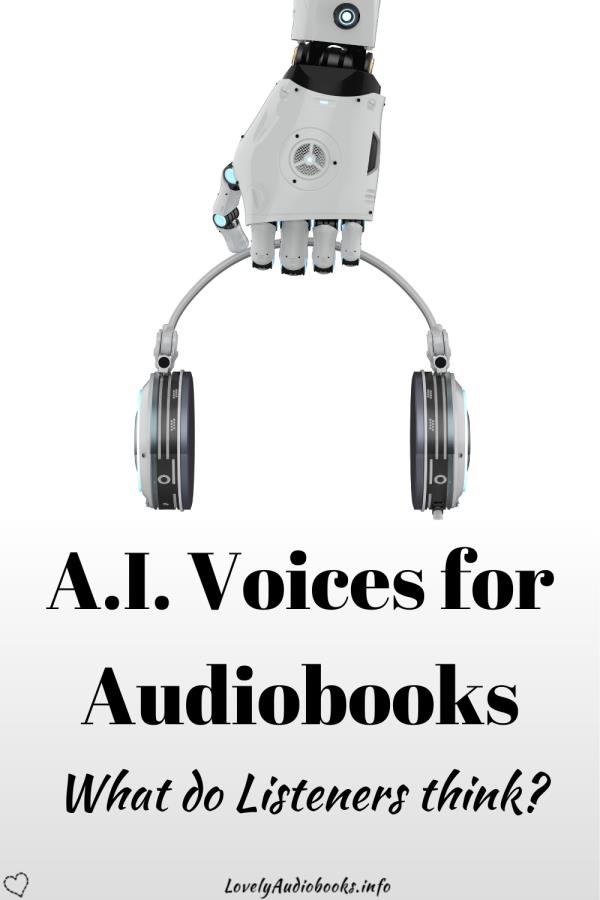
Anger about AI Audiobook Voices
Many audiobook fans are “narrator-motivated”, meaning, they would happily buy an audiobook from an author they don’t know, or in a genre they don’t usually favor, as long as it is narrated by their favorite. “I would listen to him/her read the phonebook!” is a popular line.
New authors trying to get into the audiobook business can get a strong start if they can afford to hire a popular voice actor because the talent will bring their own fanbase and avenues of promotion.
Every audiobook listener I know, even the casual ones, has a favorite narrator. And that name will always be a draw for them, even if they never go to TikTok, Facebook, or Instagram, and just browse Audible a bit every other month. There is a reason why Audible gives you suggestions for other titles read by the narrator you just listened to!
And the die-hard audiobook narrator fans are actively angry about AI voices for audiobooks! They fear that the market will be smaller for their favorite human voices. And they feel it is simply shitty to do this at all because the narrator is so important for our audiobook experience.
For new voice actors or lesser-known ones doing niche titles, this is an even bigger problem. They don’t have much of a fanbase, and they still have to be more expensive than AI voices. It will be hard for them to compete, and their livelihood is even more threatened by this development.
For those of us listening to audiobooks every day, loving voice actors dearly, and basically living and breathing audiobooks, the whole discussion about AI voices for audiobooks can feel a bit like a slap in the face because an audiobook is a very intimate experience.
You have a person in your ear, telling you a story, eliciting emotions in you. The idea that this very human, very personal side of it gets ignored, and we would have to listen to a robot voice, feels foreign and worrying. It devalues our beloved voice actors as well as our own aural experience.
And that means some audiobook fans (me included) refuse to ever pay for an AI-generated audiobook on principle grounds, no matter how good the AI voices get.
I can also see a vicious circle in the making here: Indie authors wanting to bring out their first audio, scared of the investment, choosing AI because Amazon Audible offers it for free, then their audiobook won’t generate royalties, and they won’t bring out their books in audio format again, “because it isn’t worth it”.
The audiobook market is very distinct from the ebook market and needs its own marketing. Audiobooks as an afterthought hardly work. And they definitely won’t work if new authors try to save on the voice talent!
Audible and ACX
Until 2023, a lot of the AI audiobook discussion was theoretical. Audible, the biggest audiobook marketplace in the world, didn’t allow AI-narrated audiobooks. And we thought we were “safe”.
But then authors started sharing emails they had received from Amazon, inviting them to a beta test to have their ebooks turned into audio “with just one click”.
After a highly criticized beta test, this feature became widely available, and these days Audible is absolutely flooded with thousands and thousands of Virtual Voice productions. With one free click, authors generate an AI-voiced version of their ebook that is then either included in Audible Plus where subscribers can borrow it, or is sold for a set price.
Structurally, these virtual voice audiobooks have few ratings and bad reviews. Many of these books look like the ebook version and the cover were AI-generated as well.
Some more popular authors have also used it, though, and I have seen books with over 100 ratings. Usually, though, the reviews criticize the audio version.
Related article: How to filter out Audible Virtual Voice
The Human Experience
AI voices for audiobooks are comparable to CGI actors in movies. It kind of works, it sometimes works surprisingly well to patch something up. And yet, overall, you want the human experience in art. AI can’t emulate that.
Personally, I would like to see an improved text-to-speech app come out of these AI voice developments. Instead of trying to make more money with audiobooks by cutting out the real voice actors who made audiobooks so popular in the first place, give screenreader users better options!
Many books, especially older niche titles, don’t have an audio version. And if we could have that read to us in a reasonably acceptable way, that would be a really cool thing and wouldn’t take anything away from human narrators.
But replacing human voice actors with AI as a way for a company like Amazon to earn more money is a bad and shortsighted business strategy. Audiobook listeners care very much about the narration quality and will not buy (or keep) an audiobook that is not read with that magical spark that only a good voice actor has!
What about you? Would you buy audiobooks with AI voices? Please share your opinion in a comment below!
Eline Blackman (pronouns: she/they) fell in love with books as a child – with being read to and reading herself. 11 years ago, she bought her first Audible book. It was love at first listen! An average of 200 audiobooks per year has become the new normal, and you will rarely see Eline without a wireless earbud. Romance and Fantasy are the go-to genres for this audiobook fan.
Thank you for sharing all this information. It’s very tempting to click on those generate audiobook in the new KDP virtual beta program. I’ve produced 7 audiobooks so far with real narrators and it is pricey but they sound amazing!
Thanks for your comment! Great to see input from an author here 🙂
Things have developed swiftly after I published this article and there aseem to be several free options for authors now. Which on the one hand, worries me on a new level because, as you say, it’s obviously very tempting for indie authors. On the other hand, I do appreciate that these free options are available because, to me, the companies that started producing AI audiobooks for money two or so years ago seemed to make indie authors the customer and didn’t keep listeners in mind at all.
I listen to audio books frequently. I can very much tell the difference between a human and AI generated narrator. For one thing, AI narration is almost inhumanly fast paced. No human can maintain that pace when reading. It is tiring to listen to because it requires more attention and concentration to follow. Also, there are no emotional nuances which is important to the context of any work of fiction. AI might work for nonfiction but that is not my preferred choice of reading.